
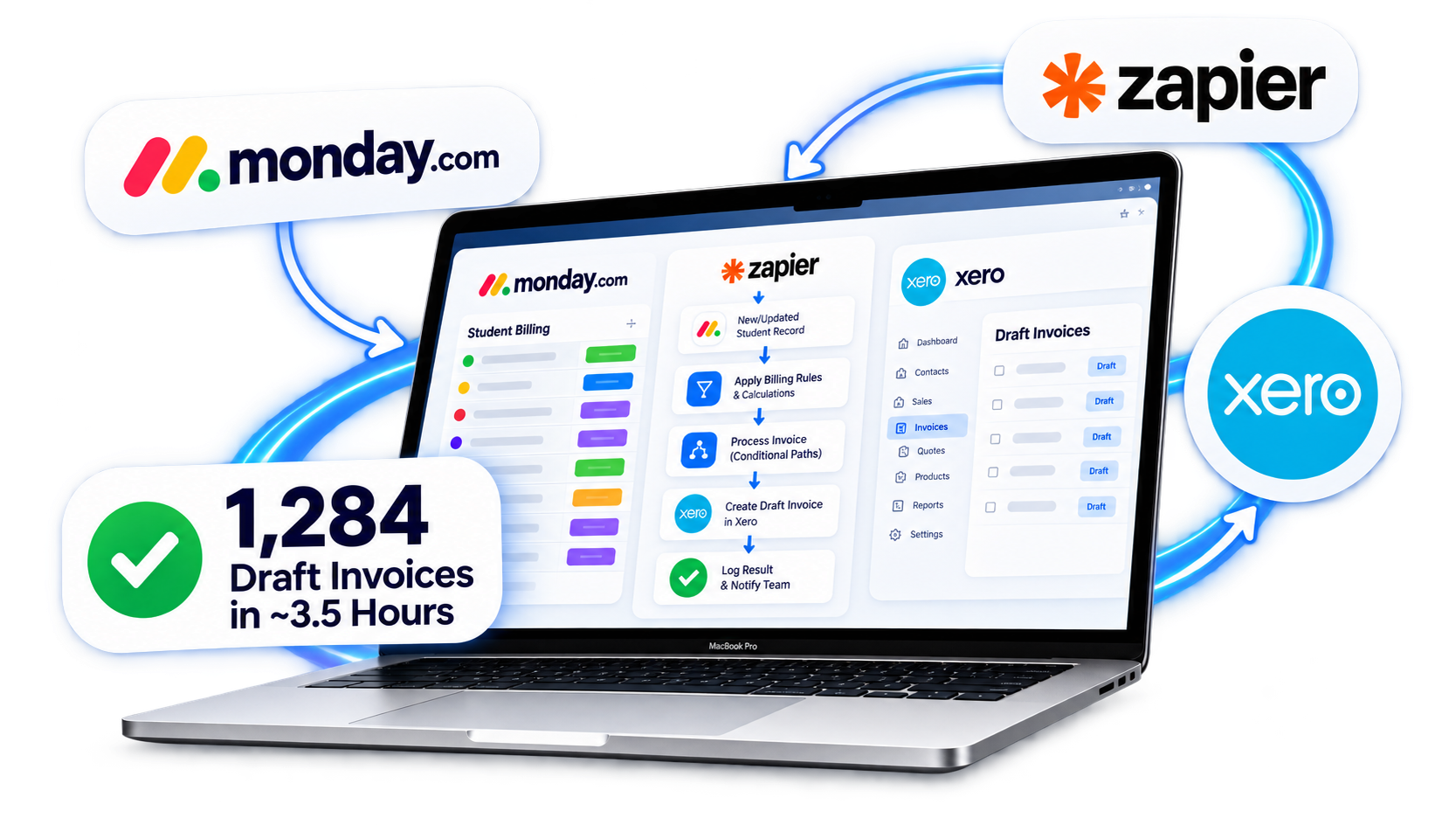
How a connected monday.com, Zapier and Xero workflow generated 1,284 draft invoices in approximately 3.5 hours — while improving accuracy, visibility and the organisation’s ability to scale.
Previous Process (±4 People)
Automated Workflow
Draft Invoices (Large Run)
First-Pass Accuracy (Latest Run)
Group-Wide Billing
Every month, around four people spent approximately 1.5 weeks preparing invoices across a growing group of schools. Different packages, services, discounts and payment arrangements made every billing cycle increasingly complex.
The real challenge wasn’t simply creating invoices faster. It was building a process that could handle growth without administrative work increasing at the same rate.
By reducing repetitive invoice preparation, the finance team can focus on exceptions, reconciliations and collections, while the business gains a billing process that can accommodate more customers and greater complexity.

See how we transformed a complex, time-consuming invoicing process into a connected, automated workflow using monday.com, Zapier and Xero — generating 1,284 draft invoices in approximately 3.5 hours.
Creating a draft invoice in Xero was straightforward. The real challenge was determining the correct amount for each account by evaluating multiple billing variables, with some schools having as many as 18 different billing combinations.
For the user, creating an invoice can be as simple as selecting the relevant account and triggering the workflow.
Behind that action, conditional paths evaluate billing rules, apply the correct calculations and route the information into the appropriate Xero environment.
The action is simple because the complexity has already been engineered behind it.
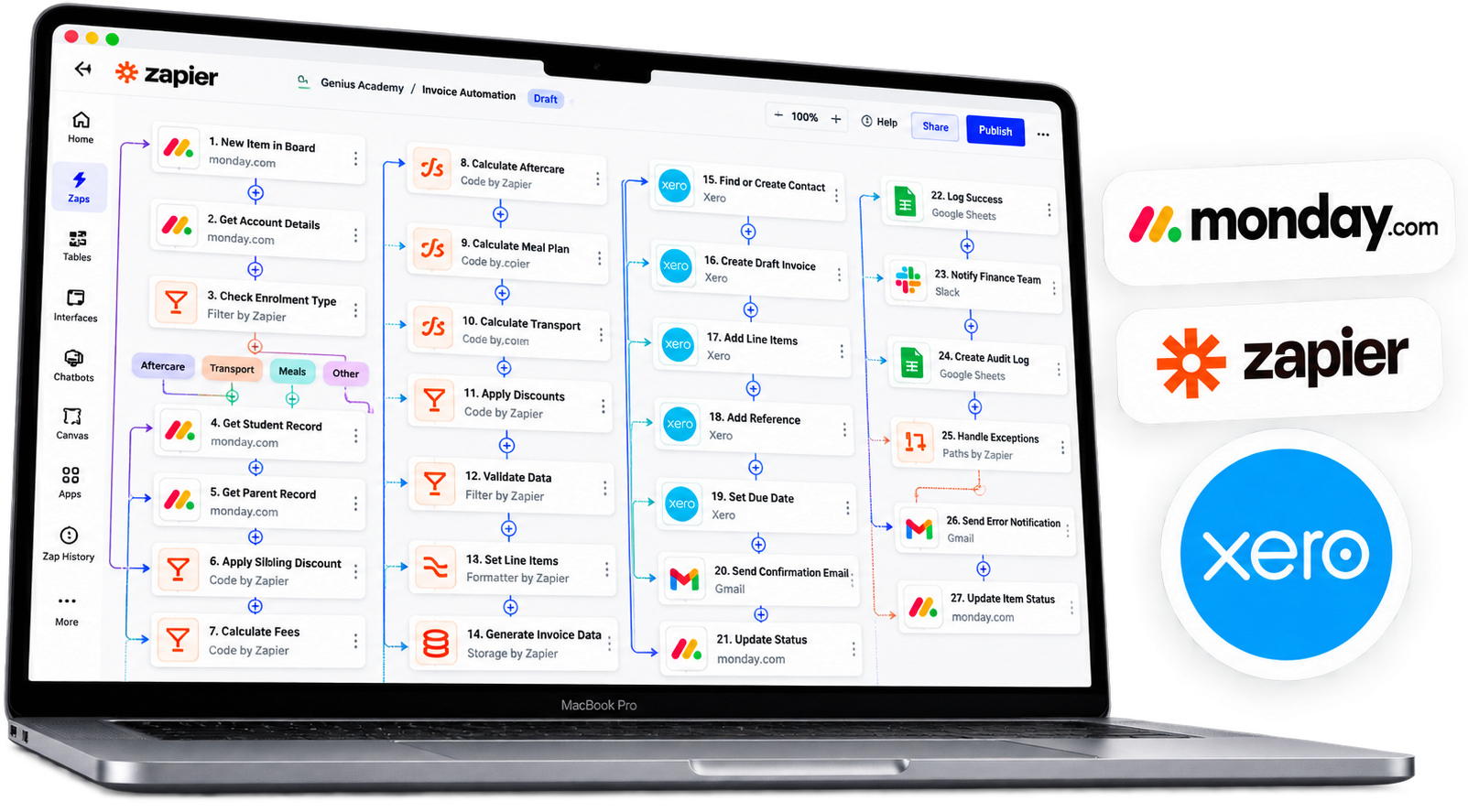
Student and billing information
Packages, services, discounts and arrangements
Processing rules and routing
Creation in Xero
Exceptions and final checks
In one demonstrated account, the student had aftercare, a swimming package and a 10% sibling discount. The expected invoice amount was R2,529.50. After triggering the workflow, the system created a Xero draft matching that amount, with the relevant services and discount applied.
Before
Manual processing, repetitive administration and reliance on staff knowledge.
After
Automated invoice preparation with consistent billing rules, leaving the team to focus on exceptions and final review.
Automation isn’t just about making processes faster. It’s about making them more reliable.
The initial rollout achieved approximately 95% first-pass accuracy. Through ongoing testing, adjustments and refinement over roughly three months, the system achieved 100% first-pass accuracy in its latest confirmed billing run.
Designed to support 12 schools, the automation accommodates different packages, additional services, discounts and billing arrangements. By standardising invoice preparation while retaining human oversight, it reduces administrative workload and provides a scalable foundation for future growth.
One connected automation designed for the group.
Handles different packages, services and billing rules.
Standardised draft invoices with human review.
Built to adapt as billing needs evolve.
The workflow connects monday.com, Zapier and Xero. Billing information is selected in monday.com, processed through conditional rules in Zapier and used to generate draft invoices in the appropriate Xero environment. Exceptions and final checks remain subject to human review.
Yes. The system was designed to account for school-specific packages, aftercare, meals, swimming, discounts and payment arrangements. Conditional logic determines which billing rules apply to each account before creating the draft invoice.
Data quality and exception handling are important parts of the process. Through ongoing testing and refinement, the system improved from approximately 95% first-pass accuracy at rollout to 100% in its latest confirmed billing run. Human review remains part of the workflow to identify exceptions and verify draft invoices.
No. The automation reduces repetitive invoice preparation so the finance team can focus on exceptions, reconciliations, collections and other higher-value responsibilities. Draft invoices still go through human review before approval, keeping the team in control of the final billing process.
No. This project used monday.com, Zapier and Xero, but a similar automation could be built around your existing systems. Depending on your processes and available integrations, that might include Google Sheets, a CRM or another business management platform. The goal is to find the right solution for your workflow, rather than force you into a particular tool.
Potentially. Businesses managing repetitive billing, disconnected systems or complex administrative processes may benefit from a tailored automation. The right approach depends on the tools, data quality and operational rules involved.


Tell us how you currently prepare invoices and where the repetitive work happens. We will explore whether automation could help your team save time and handle growth.